The Hidden Risks of Ignoring Minor Foundation Cracks: What Every Homeowner Needs to Know for Early Detection
A foundation crack is easy to dismiss when it looks thin, short, and unchanged. That is exactly why foundation crack detection matters. A small crack is not automatically a structural emergency, but neither is its small size enough to tell you what caused it. The useful question is not simply, “How wide is the crack?” It is, “What is the crack doing, what is happening around it, and is any of that changing?”
Concrete and masonry can crack for ordinary reasons such as drying shrinkage, temperature-related movement, or minor construction-related changes. Other cracks can reflect settlement, water pressure, soil movement, or continuing structural movement. The safest homeowner approach is therefore neither panic nor neglect: identify the pattern, record its condition, look for related symptoms, control obvious moisture sources, and escalate when the evidence suggests movement or structural distress.
Start With the Crack, Not the Repair
Early detection works best when the first response is observation rather than patching. A repair compound can make a crack look better while leaving the underlying cause unchanged. If the crack later reappears, the new opening may provide useful evidence, but only if the original condition was documented first.
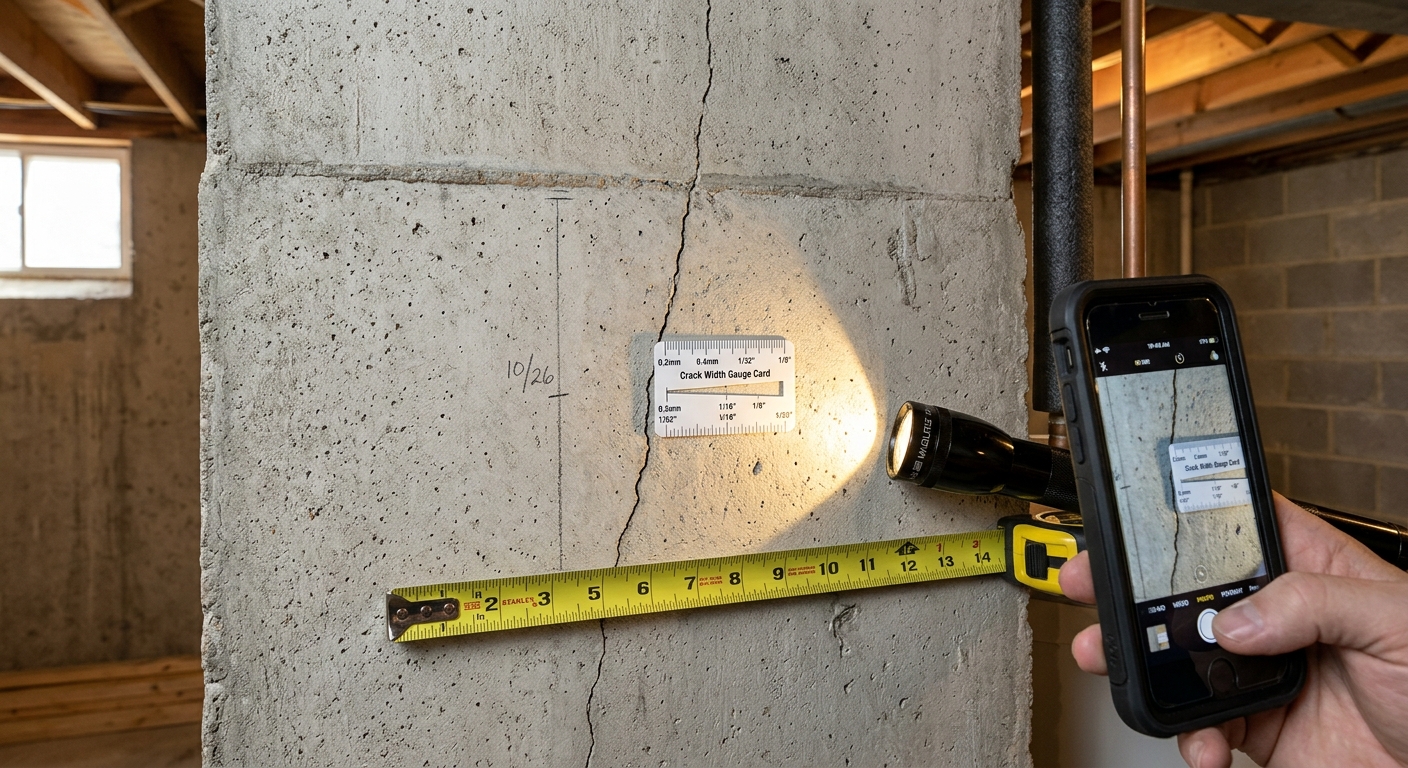
Begin by recording the crack's approximate location, length, direction, and apparent width. Photograph it from a distance so its location on the foundation is obvious, then take a closer photograph. Put a simple reference object beside the crack so later images can be compared. If the crack is accessible and safe to inspect, a crack-width gauge can provide a more repeatable estimate than judging width by eye.
Consistency matters more than precision. A homeowner does not need to turn a basement inspection into an engineering survey. The purpose of a simple record is to answer three questions later: Is the crack getting longer? Is it getting wider or otherwise changing? Are other symptoms appearing at the same time?
Why a Minor Crack Can Matter Over Time
The risk associated with a crack comes from the mechanism behind it and from what the opening allows to happen next. A stable surface crack caused by early-age shrinkage is fundamentally different from a crack associated with continuing settlement. The two may look similar in a quick glance.
Settlement is particularly important because foundations transfer building loads into the ground. When different parts of the supporting soil or foundation system move by different amounts, the resulting differential movement can put stress on walls, floors, finishes, and connections. The visible crack may be only one part of that process.
Moisture creates another pathway for trouble. A crack can become a route for water or humid air to enter a basement or crawl space. Repeated wetting can contribute to staining, efflorescence, deterioration of adjacent materials, and persistent dampness. In cold climates, repeated wetting and freezing can add another deterioration mechanism. This does not mean every damp crack is structurally dangerous, but it does mean the crack should be considered as part of a larger moisture system.
What the Shape and Location Can Tell You
Crack shape is evidence, not a diagnosis. A vertical crack in a poured-concrete wall may have a different cause from a diagonal crack that extends from the corner of a window or door opening. A stair-step crack in masonry may indicate movement through the masonry system, but seasonal thermal or moisture movement can also create cracking in masonry.
The table is a screening framework, not a diagnosis chart. For example, a vertical crack is not automatically harmless, and a wide-looking crack is not automatically proof of foundation failure. Orientation, location, movement, surrounding symptoms, construction type, and history all matter.
Moisture Is Often the Clue People Miss
A foundation should be considered as part of the home's drainage system. Rainwater that lands on the roof becomes foundation-adjacent water if gutters and downspouts discharge too close to the building. Soil that slopes toward the house can also direct water toward the foundation rather than away from it.
Look for staining, damp patches, musty areas, efflorescence, peeling finishes, or water marks near the crack. Outside, inspect whether the soil settles toward the house, whether downspouts discharge near the wall, and whether water collects after rain. Inside, note whether the crack is dry, damp, or visibly leaking.
A moisture barrier or coating may be useful in an appropriate system, but a coating should not be treated as a substitute for drainage. If water is continually accumulating against the foundation, the pressure and moisture source remain even if the visible crack is covered. In practical terms: if water is clearly the problem, fix the water-management pathway first or alongside crack treatment; if there is no moisture evidence, keep structural movement and crack activity as separate questions.
Monitor Change Instead of Relying on Memory
One of the most useful homeowner techniques is repeatable documentation. Choose a consistent photo angle, keep the same reference scale, and record the date. For a crack that is not producing urgent warning signs, periodic comparison can reveal whether it remains stable or changes.
Record the crack's location, orientation, width estimate, and length. Note weather or unusual events when relevant, such as prolonged heavy rain, flooding, nearby excavation, or an earthquake. If the crack appears seasonal, compare observations across similar seasons rather than interpreting one photograph in isolation.
This approach follows a basic inspection principle: a single observation tells you the condition at one moment, while repeated observations can reveal movement. Professional inspection procedures likewise emphasize documenting characteristics such as location, orientation, and width so changes can be recognized over time.
When a Homeowner Can Monitor and When to Escalate
Not every foundation crack requires an emergency response. A homeowner can reasonably begin with documentation and observation when a crack is small, apparently stable, dry, and unaccompanied by other signs of movement. That does not guarantee that it is harmless; it means there is enough uncertainty and low immediate evidence of distress to justify monitoring.
The decision changes when multiple indicators appear together. If a crack is changing and doors are sticking, investigate sooner. If a crack is changing and the wall is bowing or leaning, do not treat it as a simple cosmetic defect. If water is entering during ordinary rainfall, address drainage and moisture control promptly even if the crack itself appears small.
There is also an important exception for recent events. After flooding, major ground movement, an earthquake, excavation next to the home, or another event capable of changing soil or structural conditions, an old-looking crack should not automatically be classified as routine. Compare photographs and records if available, and seek appropriate professional evaluation when the event or symptoms warrant it.
A Practical Foundation Crack Detection Checklist
Use this checklist as a first-pass observation routine. It is intended to organize information, not replace an engineering assessment.
- Photograph the full wall so the crack's location is unmistakable.
- Take a close photograph with a consistent reference scale.
- Record the crack's approximate length, direction, and width.
- Note whether the crack appears dry, damp, stained, or actively leaking.
- Look for related symptoms such as bowing, displacement, sticking doors, or uneven finishes.
- Inspect exterior grading around the affected wall.
- Check gutters and downspouts for concentrated discharge near the foundation.
- Look for standing water or unusually soft, saturated soil near the wall.
- Repeat photographs from the same position when monitoring a non-urgent crack.
- If several warning signs occur together, stop treating the issue as a cosmetic repair and arrange an appropriate professional assessment.
Foundation Repair Materials Have a Limited Job
Foundation repair materials are not interchangeable solutions for every crack. A flexible sealant can sometimes accommodate small movement better than a rigid patch, while an injection system may be appropriate for particular concrete-wall conditions. Neither option answers the more important question of why the crack exists.
The same principle applies to moisture barrier solutions. A membrane, coating, or sealant may help manage water at a suitable location in the wall assembly, but it cannot compensate for poor grading, a failed drainage path, or continuing foundation movement. The correct sequence is to understand the water and movement conditions first, then select a repair method that is compatible with the actual defect.
Structural assessment tools are similarly useful only when their results are interpreted in context. A crack-width gauge can document change. A moisture meter can help identify suspicious moisture conditions. A level can help document apparent changes in alignment. These tools provide observations; they do not independently determine whether a foundation is structurally adequate.
Common Mistakes That Make Early Detection Less Useful
The first mistake is painting or sealing a crack before photographing it. Once the original surface is covered, the baseline becomes harder to reconstruct. The second is checking only the interior face of the foundation. Water and soil conditions outside may explain what is happening inside.
The third mistake is using one numerical crack-width threshold as a universal rule. Concrete, reinforced concrete, concrete masonry, brick masonry, and different structural configurations behave differently. Professional inspection guidance also considers crack location, orientation, extent, and structural context rather than relying on width alone.
The fourth mistake is assuming that every crack is caused by the foundation. Cracks in drywall, plaster, brick veneer, flooring, or finishes may result from material shrinkage, thermal movement, moisture changes, framing movement, or other causes. A foundation crack should be interpreted alongside the rest of the building rather than used to explain every nearby cosmetic defect.
The fifth mistake is ignoring recurrence. A patch that remains intact for years tells a different story from a patch that opens again after a short interval. Recurrence is information. Record it rather than simply covering it again.
Who This Approach Is For—and Its Limits
This early-detection approach is intended for homeowners who need a disciplined way to observe minor cracking and decide when additional evaluation is warranted. It is especially useful when the crack is accessible, there is no immediate life-safety concern, and the homeowner can document conditions over time.
It is not a substitute for an engineer, qualified building professional, or other appropriate specialist when there is substantial movement, significant water intrusion, foundation displacement, compromised structural components, or uncertainty after a damaging event. It also does not establish a universal “safe” crack width. A small crack in a critical location can matter more than a larger superficial crack in a nonstructural finish.
The trade-off is straightforward: monitoring costs little and creates useful information, but waiting is inappropriate when evidence points to active structural movement. Conversely, treating every hairline crack as a structural emergency can lead to unnecessary work without identifying the actual cause. Good judgment sits between those extremes.
Frequently Asked Questions
Is every foundation crack a structural problem?
No. Concrete and masonry can crack for nonstructural reasons, including shrinkage and environmental movement. The significance depends on the crack's pattern, location, activity, associated symptoms, and the construction system.
How can I tell whether a crack is getting worse?
Photograph it from a consistent position, record its approximate dimensions, and compare observations over time. Changes in length, width, depth, direction, or surrounding displacement are more informative than a single visual inspection.
Should I seal a small foundation crack immediately?
Not necessarily. If you have not documented it, photograph and record the condition first. If the crack is active, repeatedly reopening, or associated with structural movement, sealing alone may hide the evidence without resolving the cause.
Can water make a minor foundation crack more important?
Yes. Water can use cracks and other openings as pathways into below-grade spaces. Persistent moisture can also damage adjacent materials and may indicate drainage problems outside the foundation. The presence of water should therefore be investigated separately from the crack's apparent size.
Are diagonal cracks more serious than vertical cracks?
Not automatically. Orientation can provide useful clues, but no single direction proves a structural diagnosis. A diagonal crack near an opening, especially when combined with sticking doors or other movement, deserves more attention than its direction alone would suggest.
What does efflorescence near a foundation crack mean?
Efflorescence is a visible deposit left when moisture moves through masonry or concrete and carries dissolved minerals toward the surface. It can be a clue that water is moving through the assembly, but it does not by itself establish structural damage.
When should I call a professional?
Escalate when a crack is changing, repeatedly reopening, accompanied by bowing or leaning, associated with significant water entry, or accompanied by multiple building symptoms. Professional evaluation is also prudent after flooding, earthquakes, nearby excavation, or other events that could alter soil or structural conditions.
Can a moisture barrier solve a foundation crack?
A moisture barrier can be part of a water-management system, but it does not necessarily solve the cause of a crack. If water is being directed toward the foundation or drainage is inadequate, correcting those conditions is usually part of the solution. Structural movement requires a different type of assessment.
What Early Detection Actually Accomplishes
The value of foundation crack detection is not that it lets a homeowner diagnose structural engineering problems with a ruler. Its value is that it turns an easy-to-ignore defect into a documented condition. Once the crack has a location, pattern, history, and surrounding context, a homeowner can make a better decision about whether to monitor, correct an obvious moisture pathway, or obtain professional help.
The most useful decision rule is simple: if the crack is small, stable, dry, and isolated, document it and monitor it; if it is changing or accompanied by other building symptoms, investigate further; if significant displacement, active water intrusion, or event-related damage is present, escalate rather than relying on cosmetic repair. That approach recognizes both sides of the problem: many minor cracks are ordinary, but the cost of missing an active underlying problem can grow with time.
A foundation does not need to look perfect to be performing well. What matters is understanding whether the observed defect is stable, whether water is being managed, and whether the building is showing evidence of continuing movement. Early detection gives homeowners the information needed to distinguish those situations before a barely noticed line becomes a much harder problem to understand.


Comments
Post a Comment